Shopping Cart



Post author: Cacauwe
Publication date: 29/09/2026
How the size of a frame drum changes its voice, what goat skin and sinew bindings mean, and how to tune a drum by hand or with a pump.
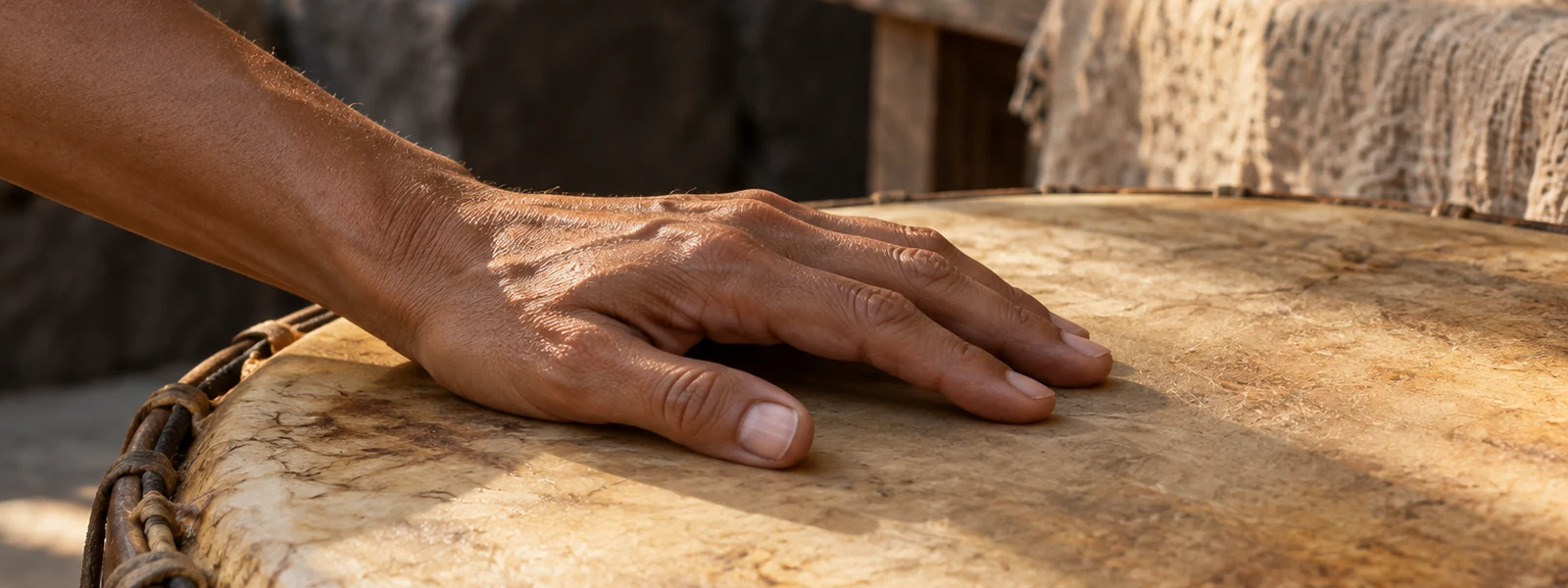
Illustration generated with AI
A shaman drum is one of the oldest instruments there is: a skin stretched over a round wooden frame, held in one hand and struck with a beater in the other. Across Siberia, Central Asia and the Americas, frame drums have been played to open a ceremony, to hold a steady rhythm for a journey, or simply to gather people around a fire.
If you are choosing your first drum, three things decide how it will sound and how it will feel to play: the size, the skin and the way it is tuned.
Quick answer
For a first drum, choose a 40 cm drum with a pump. For travel or quiet solo playing, choose 30 cm. For leading a circle or playing outdoors, choose 50 cm.
The diameter of the frame is the biggest single factor in how a drum sounds.
30 cm is a small drum. It is light, easy to hold for a long time and easy to carry. Its voice is higher and quicker, with a short, bright note. A 30 cm drum suits someone who plays alone, travels with their drum, or wants a steady pulse without filling a whole room.
40 cm is the size most people start with, and the one we carry in more versions than any other. It is large enough to have a real, rounded low note and small enough to hold in one hand through a long session. It works indoors and outdoors, alone or in a small circle.
50 cm is a big drum. The note is deep and it carries: you feel it in the chest as much as you hear it. A 50 cm drum is heavier and asks more of the arm that holds it, but it is the one to choose if you want to lead a group or play outside where sound disappears quickly.
When in doubt, choose 40 cm. You can always add a smaller or larger drum later.
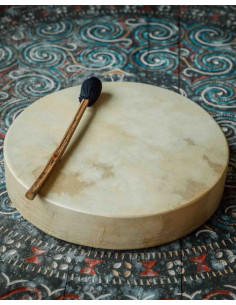
The drums in our range are made with goat skin, stretched over the frame and laced with natural sinew bindings at the back. The bindings cross to form the handle you hold.
Goat skin is thin and responsive. It answers a light stroke with a clear note and a heavy stroke with a full one, so you can play quietly or loudly on the same drum. Each skin is different in thickness and markings, which is why no two drums sound or look exactly alike.
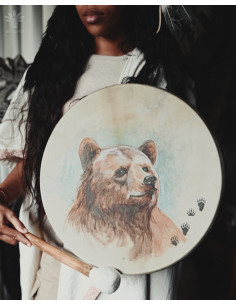
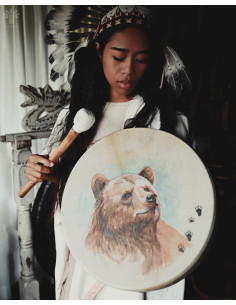
Some of our drums are painted on the face: a wolf, a bear, a dragon. The painting does not change the sound much. It changes the character of the drum, and the person who plays it often chooses by that.
A natural skin reacts to the air around it. In dry, warm weather it tightens and the note rises. In damp or cold weather it slackens and the note drops and turns dull.
Not a defect
This is not a defect. It is how skin drums have always behaved, and players learn to work with it.
There are two ways to bring a skin drum back to the note you want.
By hand. A traditional way to tighten a slack skin is to warm it gently, holding the drum near a heater or in the sun for a few minutes, never too close. To lower the note of an over-tight skin, some players wet the membrane lightly. On our 40 cm bear drum, a damp membrane gives a deeper sound.
With a pump. Several of our drums, including the 40 cm wolf and bear drums and the 50 cm dragon drum, come with a pump. The pump lets you add air to adjust the tension of the skin: more air for a higher, tighter sound, less for a deeper one. It makes tuning quick in changing weather.
If you want to set up and play without fuss, choose a drum with a pump. If you enjoy learning your drum's moods, a drum tuned by hand will teach you a lot.
Check before you buy
Check the product page to see what is included. The 40 cm wolf drum, for example, comes with a mallet, a pump and a bag. The smaller 30 cm drums come with a bag and a stick. A bag matters more than it seems: it protects the skin from knocks and from sudden changes in temperature.
The 50 cm dragon drum has a handle hand-carved in wood in the shape of a dragon, which also makes the larger frame easier to grip.
Hold the drum by the bindings at the back, with the skin facing away from you. Strike near the edge for a sharper sound and nearer the centre for a deeper one. Start with a simple, steady beat, about two strokes a second, and keep it going. The rhythm, not the technique, is the point.
For a first drum, choose a 40 cm drum with a pump. For travel or quiet solo playing, choose 30 cm. For leading a circle or playing outdoors, choose 50 cm.
You can see all our drums, alongside jaw harps and other ceremony instruments, in the instruments category. Two good places to start are the 40 cm wolf drum and the 50 cm dragon drum.
When in doubt, choose 40 cm. You can always add a smaller or larger drum later.
In damp or cold weather it slackens and the note drops and turns dull.
The pump lets you add air to adjust the tension of the skin: more air for a higher, tighter sound, less for a deeper one.
The painting does not change the sound much.